
Villains of All Nations by Marcus Rediker
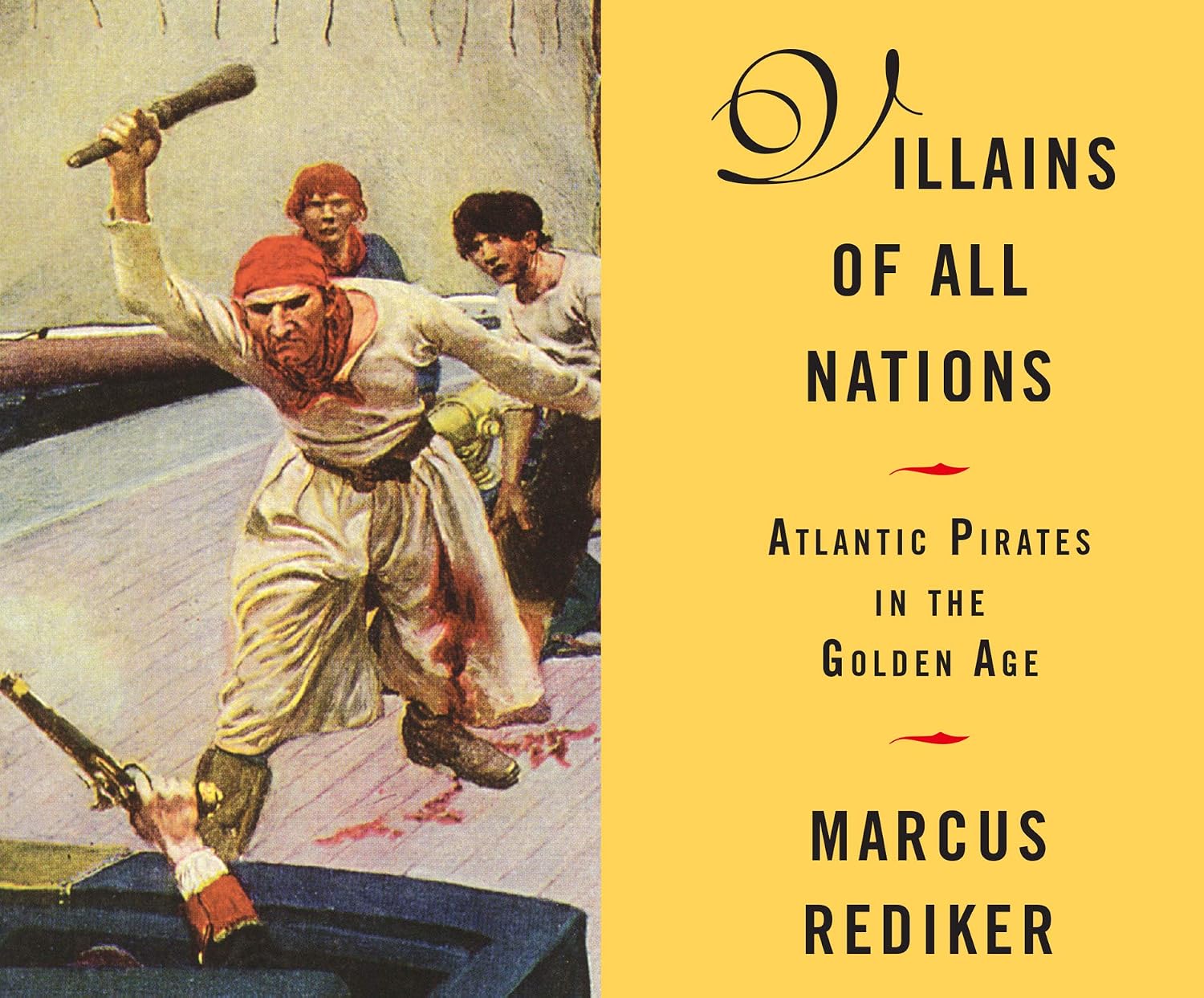
When modern-day people are prompted to think of pirates, the images that come to mind all come from a surprisingly narrow slice of history: Atlantic pirates during the period of 1716 to 1726. This period was the last of three major waves of piracy during the Golden Age of Piracy, which spanned from roughly 1650 to 1730.
The state of the seas in the early 18th century
Even by the standards of the era, being a sailor was a remarkably dangerous and undignified occupation. Sailors faced many problems on the job, including gruelling physical labor, long shifts, insufficient and often spoiled food provisions, brutal discipline such as flogging from their officers, cramped living quarters, widespread infectious diseases, frequent accidents, and low wages that were often withheld. Sailors were mainly young men from port cities with no wives, children, or meaningful property; nearly all of them came from the lowest socioeconomic classes. Among non-sailors, sailors were known for their rugged appearance, gruff manners, vulgar speech, and love of alcohol. Sailors were unrooted and cosmopolitan people, more attached to their fellow sailors than to any land-based nation or culture.
The world had five major imperial powers with territories on both sides of the Atlantic: Great Britain, France, Spain, Portugal, and the Netherlands. From 1700 to 1713, the imperial powers had fought the War of Spanish Succession, eventually resolving it in a peace treaty. After the war, with war-driven demand for sailors drying up, wages for sailors fell by half within a matter of years. With the balance of power tilting so strongly towards employers, poor treatment of sailors intensified as well.
On some cargo and slave trade ships, sailors launched successful mutinies against cruel and abusive sea captains. Once in control of a vessel on the lawless high seas, these sailors found themselves outside the reach of any worldly authority. Facing the wrath of the law if they returned to mainstream society, these sailors became outlaws, sustaining themselves through robberies of other vessels.
The art of the capture
The preferred targets of pirates were merchant and slave transport vessels. Once pirates approached a ship, they would raise the much-feared black jolly roger flag, the universally-used and universally-recognized symbol of piracy. Pirate ships were well-armed and had much more men on board than similarly-sized merchant vessels, giving them the advantage in any battle. In most cases, the victims surrendered immediately, fearing battle casualties in case they fought and torture in case they were overpowered.
Pirates would then board the captured ship and proceed to loot it. Pirate plundering was rowdy, chaotic, and wasteful; pirates frequently destroyed cargo, threw cargo overboard, or left valuables behind.
Pirates acted with a certain solidarity towards their fellow sailors, not acting violently against those who didn’t fight. Pirates often interrogated the sailors of captured ships about the ship’s captain and his character. Pirates were civil and transactional with captains who were respected by their crews, whereas captains accused by their crews of poor treatment could end up tortured or killed.
At the end of a capture, pirates would offer the captured sailors the opportunity to defect from their employers and join their pirate crew. The majority of sailors who became pirates did it through this pathway of capture and recruitment rather than through a mutiny. Seeking internal cohesion within their crews, pirates sought sincere volunteers and usually didn’t coerce anyone into joining them.
Pirates would then gather to decide what to do with the captured vessel. If the vessel wasn’t suitable for retrofitting into a pirate ship, it would be returned to its crew, minus the stolen cargo and any recruited pirates. If the vessel was suitable as a pirate ship, it would become a new pirate ship, with the existing pirate crew and the new recruits merging and then splitting into two blended crews; non-volunteers would be carried ashore and dropped off. If the pirates were particularly angry or if they wanted to spite the ship’s owners, they would destroy the ship by sinking or burning it.
Even though there were never more than about 2500 active pirates worldwide at any given time, pirates were extremely disruptive to maritime trade. Many pirate captains successfully performed this capture routine dozens of times throughout their careers, with the most successful captains making hundreds of captures.
Pirates were most active in the Caribbean, but also had a presence around British America, West Africa, and the Indian Ocean. Pirates needed to go to land ports to sell their booty, buy provisions, and collect intelligence on the comings and goings of local vessels. The most popular rendezvous points for pirates were the Bahamas, Sierra Leone, and Madagascar, all of which were preferred thanks to their lawlessness.
Pirate careers tended to be glorious but short, almost never exceeding 1-2 years. On top of the usual hazards of life at sea, pirates faced the additional hazards of dying in battle or of being captured and hanged by governments. It is unknown and unknowable how many pirates left the pirate lifestyle, quietly reintegrated into mainstream society, and successfully kept their criminal pasts a secret. Contrary to the popular trope, pirates did not bury their treasure; the most common outcome was that they went to taverns and squandered their newfound wealth immediately.
The culture of pirates
Since most pirate ships were captured ships and most pirates were recruited, the pirate ships of the world all belonged to one of a few major lineages. Since pirates attacked ships from many nations, pirate crews usually ended up being a diverse mix of nationalities. As a result of this interconnectedness, pirate ships around the world were remarkably similar in their customs.
Pirates sought to make their ships a utopia for sailors. Rejecting the hierarchy-obsessed and class-obsessed cultures they came from, pirates organized themselves in a highly egalitarian and collectivist manner. Pirates elected and deposed their officers by popular vote. Pirate captains had absolute authority during high-stakes moments such as battles and chases, but they were subject to majority opinion at all other times. Questions of where to sail next or how to discipline rule-breaking crew members were handled democratically by the crew as a whole.
The quartermaster was the second most powerful officer on a pirate ship, responsible for the equitable distribution of provisions and booty. Pirates allocated booty based on a shared ownership structure. Most sailors had one share, whereas officers and sailors with rare skills got 1.25, 1.5, or 2 times the standard share. This was a much more equal and transparent pay structure than what was employed in navies and merchant services. Unconcerned about labor costs since they didn’t operate on a wage structure, pirates had large crews relative to their vessel size, which reduced the average workload per crewmate. In a sort of social security system, pirates set some of their booty aside in a common fund for sailors who sustained permanent injuries on the job. The modern image of a pirate with an eyepatch, hooked hand, and peg leg is exaggerated, but it is a nod to the fact that pirate ships often had disabled sailors on board who they did not abandon.
Compared to legal vessels, pirates offered more generous rations of alcohol and had fewer regulations around drinking. For many recruits, the prospect of getting more alcohol was a bigger draw into the pirate lifestyle than the prospect of riches. This tolerance for drunkenness had some negative side effects, including petty quarrels, poor battle-readiness, and frequent accidents.
Pirates were loyal to the global pirate community, seeing all pirates as fellow sailors and fellow victims of mainstream society. Pirate ships never attacked other pirate ships. Since the jolly roger flag was usually enough to invoke surrender from targeted vessels, pirates understood that they needed to do their part to uphold the jolly roger’s fearsome reputation. Pirates mounted bloody revenge against navies who hunted pirates and governments who prosecuted them. In the most noteworthy cases, pirates blockaded ports or set fire to shipyards.
The crackdown
Imperial elites responded to the surge of piracy with moral indignation. By disrupting the free flow of cargo and people across the seas, pirates cut the economic links that kept the trans-Atlantic empires running. By disregarding state authority and private property, pirates directly challenged the social order. By living completely free of the restraining forces of law, religion, family, and honest labor, pirates were savages in the purest sense of the term. By exploiting the ocean’s lawlessness to prey on the weak, pirates were thugs, thieves, and traitors all rolled into one.
Long-distance merchants, the main victims of piracy, begged their governments to do something about it. Whereas governments had historically tolerated piracy as long as other nations’ ships were the targets, they increasingly adopted the view that pirates were the common enemy of all mankind. As men of no nation, pirates were deemed not to be entitled to the protection of any government.
Governments first tried to get pirates to return home by offering amnesties, but abandoned this approach after many pirates accepted amnesty and then returned to piracy immediately. Great Britain established an English-style government in the Bahamas, depriving pirates of their favorite lawless safe haven. Navies sent out vessels to pirate hotspots with the express aim of attacking pirate ships. Piracy had long been a capital crime, but governments upped the ante with spectacular trials and spectacular hangings of captured pirates in port cities. By hanging pirates under the jolly roger flag and leaving the corpses to rot in prominent locations in harbors, governments sent a loud message to local sailors that anyone who sailed under a black flag would die under a black flag.
At their trials and executions, pirates often blamed mistreatment from their former employers for forcing them into the pirate lifestyle. The pirates often expressed contempt for the proceedings, mocked the cowardice of elites who took cover behind self-serving laws, and whole-heartedly agreed with pastors who warned them that they were destined for hell. Having lived in a dangerous world where death was ever-present, the defiant courage of pirates in the face of death made a lasting impression on the general public.
The imperial powers’ war of extermination against pirates escalated throughout the 1720s and grew increasingly bloody. The problem of piracy was largely contained by 1726. Occasional mutinies and occasional acts of piracy still occurred, but they never again escalated into runaway lineages of captured vessels. Great Britain solidified its status as the world’s predominant naval power, greatly expanding the African slave trade in the coming decades.
Despite the campaigns of demonization made against them, Atlantic pirates would go on to develop a romantic aura. Since pirate crimes occurred far from the public eye, their public image was easy to whitewash. As poor people robbing the rich, the stories of pirates had a Robin Hood-esque sense of justice to them. As renegades who had broken off from society and established an alternative life at sea, pirates symbolized freedom. Pirates became both heroes and monsters in popular culture, mirroring the fates of other barbarian and rebel groups throughout history.